
How to Make Good Gravy
It's arguably the most important thing on the table.
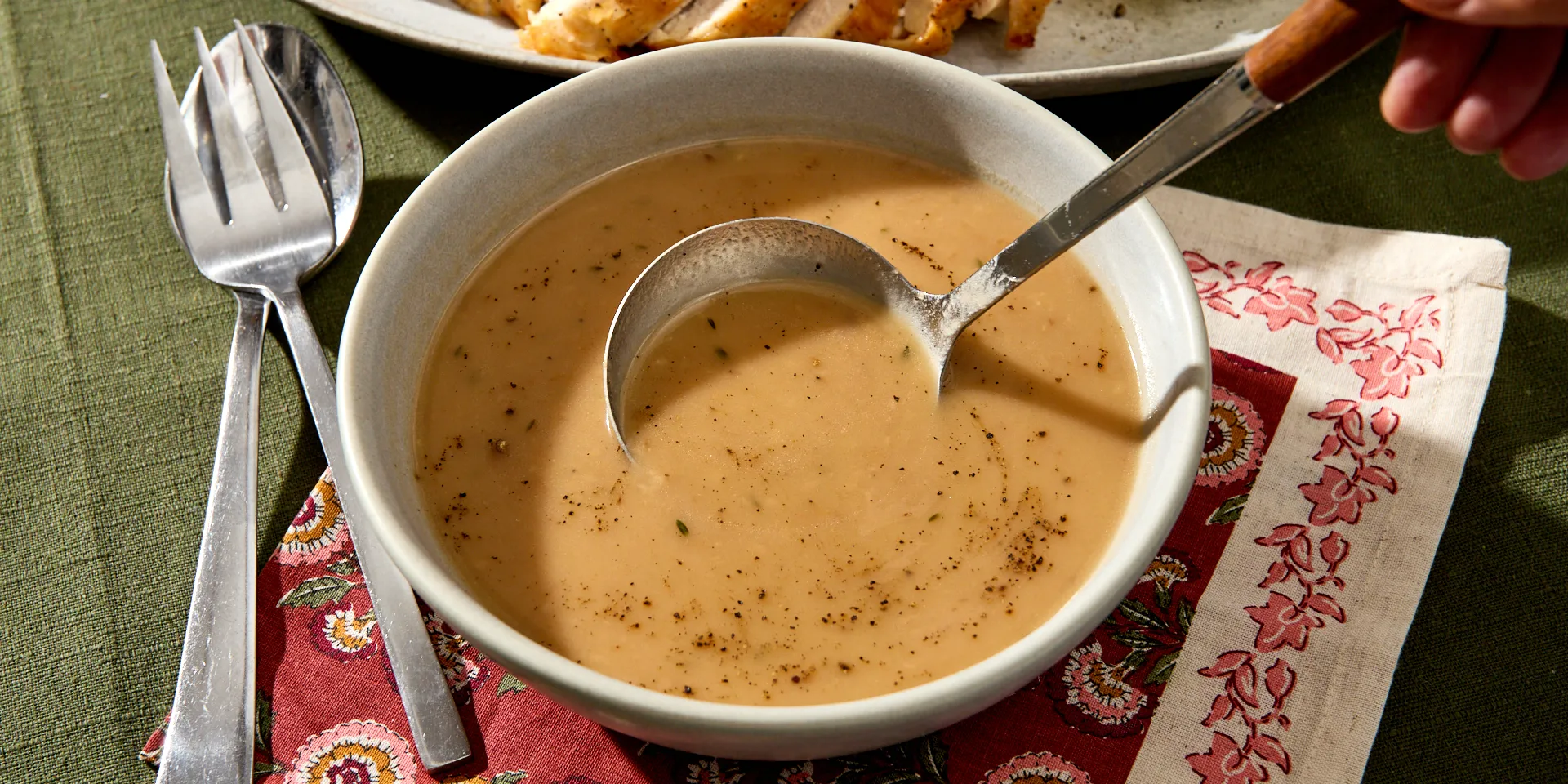
The problem with most gravy is that it’s an afterthought, rushed together after the turkey is roasted and the sides are resting, leaving it too thick, bland or overly runny. But gravy is one of the most important things on the Thanksgiving table. It can resuscitate the driest turkey or save the blandest side dishes. And mashed potatoes without a puddle of gravy feel naked to me.
Here’s how to make the best gravy you can—without a lot of fuss or last-minute worries. This is something amongst the chaos of Thanksgiving cooking that you can easily control.
Start with good stock

The best thing you can do ahead of Thanksgiving is make a batch of Turkey Stock. The last thing you want to do on the big day is deal with a simmering stock pot.
Homemade stock is contentious stuff here at Milk Street. Some feel store-bought, boxed stuff is just fine, or even water, but I’d argue that making homemade stock is time well spent. It has a deep, rich, fundamental flavor and a silky texture that can’t be touched by the boxed stuff. It's easy too.
The best stock starts with bony bits and offcuts. Bony, collagen-rich turkey parts give the stock flavor and body. Your turkey should have a neck in the cavity, which is a good start. If you’re spatchcocking before applying a dry brine, you’re in even better shape. Legs, wings or drumsticks can typically be bought at the supermarket in the weeks leading up to the big day.
Another angle is to use smoked turkey parts, which are widely available at most supermarkets. They’ll add a deep umami and smoky-sweet flavor to the broth that suits most anything on the Thanksgiving table. Cut the meat into rough hunks to speed along the rate it infuses the broth.
One caveat: Smoked parts are (obviously) cooked and thus contain less collagen than raw bits, so an all-smoked meat gravy would be inherently less velvety. if smoked gravy is your thing, I would suggest combining both smoked and raw turkey parts.
But turkey isn’t the only flavoring agent in turkey stock. Basic gravy aromatics should include coarsely chopped onion, a little carrot and a little celery (or fennel—A hint of anise works well with turkey and adds a sweeter flavor than celery). The classic ratio is twice the amount of onion to carrot and celery. Bay leaves are a given, and I like to include a little rosemary, sage and thyme (If you’ve got them). You can even tie them into a bouquet garni so you can fish them out with ease.
Of utmost importance is how you cook those ingredients. I strongly encourage deeply browning the vegetables and turkey parts for a richer flavor and fuller color. You can do this in the oven—like we do in our recipe for Make-Ahead Turkey Stock—or on the stove. Go light with oil, sprinkle with salt and cook over medium heat until the vegetables and meat are richly browned. And if something sticks to the bottom? All the the better—that flavorful fond will release as the broth simmers.
Simmer on low for 3 hours and then strain well, pushing on the solids to extract as much flavor as possible. Any fat will rise to the top and firm up when refrigerated, which I scrape off and use to make the roux for my gravy, layering on the flavor.
How to thicken gravy

There are three basic ways to thicken your gravy: roux, cornstarch slurry and Wondra, a very fine, ground wheat flour that thickens instantly.
A cornstarch slurry will thicken liquids as soon as it comes to a boil. Figure about 1 tablespoon of cornstarch dissolved into 1 tablespoon of liquid (water or starch) to thicken 1 cup of liquid. The downside is that gravy thickened with cornstarch doesn’t reheat well because the starches break down.
Wondra “quick-mixing” flour is a pre-cooked, ultra fine-ground flour designed for gravy. It works! But so does roux or cornstarch, which are a fraction the price. (And, unlike Wondra, neither are a single-use ingredient that will linger in your pantry.)
The most interesting way to thicken turkey gravy? Gingersnaps. In our Gingersnap Gravy, the cookies do the work of a roux to thicken this gravy, so there’s no need to cook butter and flour, gradually whisk in liquid and worry about lumps. The crushed cookies are simply added to the base, then simmered until dissolved. For heightened savoriness, we include dried mushrooms and add a little soy at the end. These umami-rich ingredients are especially helpful if you don’t have turkey drippings to enrich the gravy. Widely available Mi-Del gingersnaps work well because they are flavored only with ginger. Cookies containing cinnamon and other spices made the gravy taste like, well, spice cookies.
How do I make a roux?
Roux, however, is my favorite way to thicken, and it's the method we use for our simple Turkey Gravy. At its most basic, it’s simply equal parts all-purpose flour and fat, cooked to varying extents, which erases its starchy flavor and prevents it from clumping. The fat—be it butter or oil—coats the starch granules, which prevents them from clumping up once introduced to liquid. They then swell up as they gelatinize in the hot liquid to thicken the gravy.
The longer and darker a roux is cooked, the less thickening power it has. Think how roux is used in Cajun cooking: It’s cooked near mahogany dark and barely thickens gumbos or etouffee (that’s what the okra or file powder is there for). For gravy purposes, roux is typically cooked to blond, which gives it a creamy quality and slightly nutty flavor. Remember, its chief duty for gravy is thickening, not flavor (that said, cook it darker if you want toastier, nuttier, bittersweet flavor, but keep in mind that you’ll need more of it to thicken the gravy (which can be a bit of trial and error).
For 1 cup of liquid, figure 1 ½ to 2 tablespoons of flour and an equal amount of fat (for a blond roux).
If you’re concerned about timing on the big day, or new to roux, it can be made ahead of time and stored in the refrigerator. Simply rewarm the roux until softened and crumbly looking before streaming in the broth while whisking. If you do get clumps, just whisk harder! or use the back of a spoon to mash them smooth.
Is it done yet?
Gravy viscosity is a matter of personal taste—and controversy in some households. Some like it thin and loose while others want it thick enough that the ladle stands up straight.
I typically treat gravy like I do a custard. Once I’ve brought it back to a boil—after adding the thickener—I‘ll reduce the heat to low, whisking and simmering to ensure it's fully and evenly blended. Then I'll run a spatula or wooden spoon across the bottom of the pan to see if it leaves a clean streak. That's thick enough for me. Remember: It'll thicken further as it cools down off the boil. If it thickens up too much, whisk in a splash of broth, hot water or cream to thin.
Oh no, it’s too thin!
If you’ve misjudged the thickness of your gravy and it's too thin, there are a few ways of thickening after the fact. You can simmer it down a little, but if cooked too long, it'll weaken the thickening power of the roux and your gravy will become even thinner.
A beurre manie is a classic French method of thickening without frying the flour. Equal parts softened butter and flour are smushed together to form a paste, effectively coating the starch. This paste can be whisked directly to hot liquids and simmered without clumping. Add it in small amounts until you attain the thickness you’re after.
Otherwise, go with cornstarch slurry. Dilute cornstarch in an equal part of water or broth, whisk in and bring back to a simmer. It’ll thicken instantly.
What do I do with the leftovers?
If you’re lucky enough to have leftover gravy, simply refrigerate it in an airtight container. Rewarm gently, stirring frequently, and dilute as necessary with additional broth to attain the texture you want. Reheat as little as possible to prevent the thickener from breaking down. Gravy made with roux will reheat better than that made with cornstarch.
If you’re not smothering your leftovers with it, gravy is a terrific way to enhance soups or stews. You also can fold it into grain pilafs—barley and turkey is terrific!—or even risotto. According to Marcella Hazan, turkey broth is the best broth for cooking risotto, and I’d have to agree. I always make risotto with leftover broth and shredded turkey, then finish it with any gravy I might have leftover for an ultra-creamy, rich texture and flavor.
Join the conversation on Facebook, Instagram, TikTok and Pinterest.
And if you're looking for more Milk Street, check out our livestream cooking classes with our favorite chefs, home cooks and friends for global recipes, cooking methods and more.

Matthew Card
Matthew Card is Milk Street’s Creative Director for Recipes and Products, resident coffee geek, knife collector and equipment junkie. He has 25-plus years of professional cooking, recipe development, food writing and teaching under his belt. When he’s not in the Milk Street kitchen or on the road hunting for new recipes and ideas, Matthew lives with his family in Canberra, Australia, where he does his best to dodge kangaroos on his mountain bike and is learning to love Vegemite.

