
Cold-Oven Crème Brûlée
It turns out that the cold-oven method, often used for pound cake, is perfect for crème brûlée—plus you can ditch the water bath

A fuss-free crème brûlée. Our cold-oven, no-water-bath method takes the fear factor out of this fancy dessert.

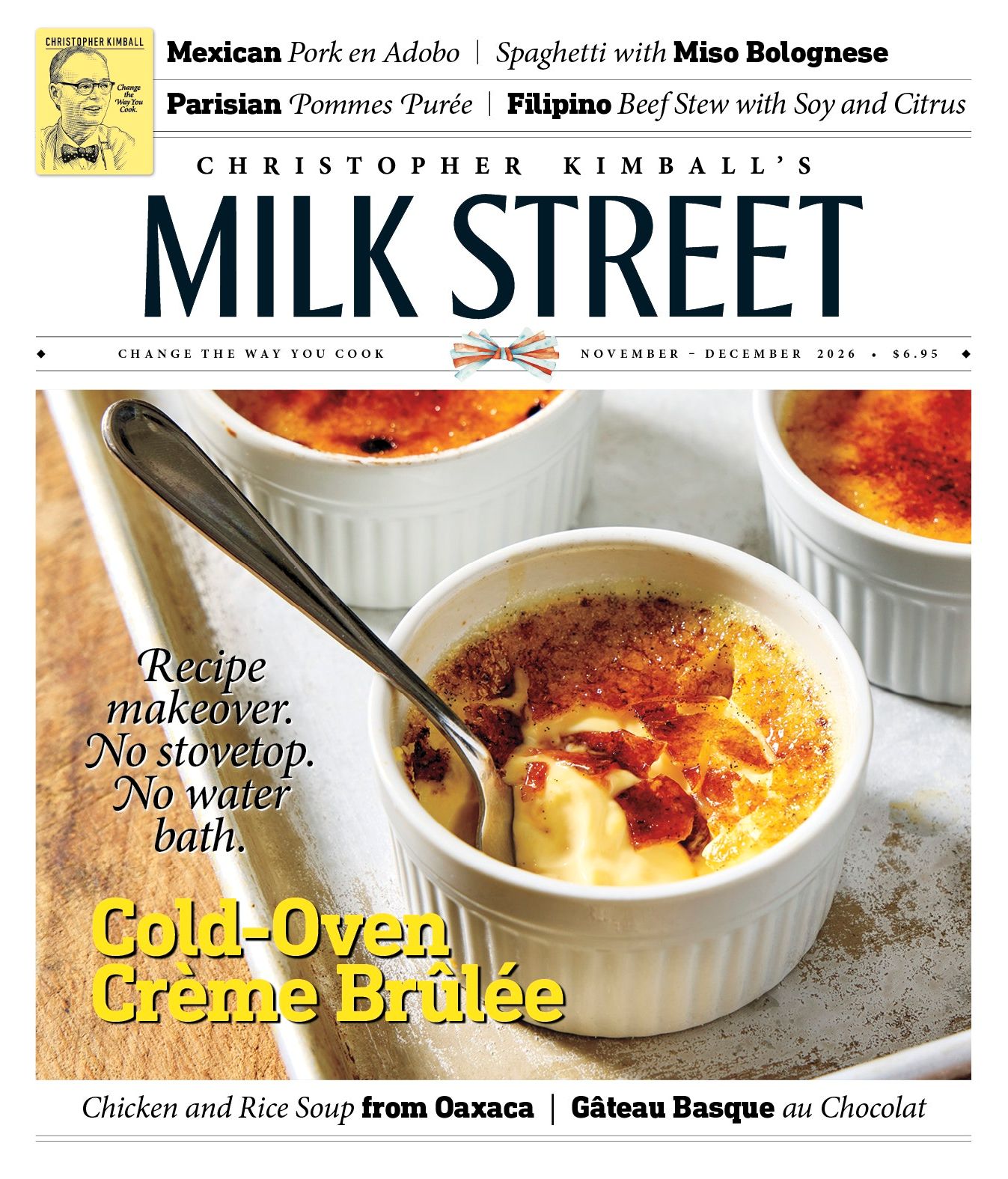
Yes, I am contrary, querulous; some call me a practicing curmudgeon. As soon as someone tells me that’s how something is done, I immediately set out to prove them wrong. In the kitchen, this means that I oppose marinating, soaking wood chips, heating milk to make béchamel and, of course, the use of a water bath. The latter makes any crème caramel or crème brûlée unwieldy since the baking dish is now heavy and prone to sloshing as one maneuvers it in and out of the oven. The question was how to do without it.
The water bath has been around for over two millennia. Cato the Elder (the great grandfather of Cato and a man who promoted traditional Roman values ) offered a recipe for cheesecake which was baked in a water bath. The term “bain marie” may have come from balneum Mariae (Mary’s bath), a 13th-century term that referred to an alchemist, Mary the Prophetess. In fact, the water bath was probably identified more with chemistry than cooking up until the 19th century, when the water bath was used extensively in baking to moderate heat. (I suspect that on a wood or coal cookstove, moderating heat was more of an issue than with a precise modern oven.)
The cold-oven baking method was promoted by gas companies who were keen to have home cooks switch to their new appliance. The allure of a cold-oven start was that it was quick (no preheating), it suggested that precision was not necessary in a gas oven and, finally, that a gas oven could heat up quickly unlike its wood or coal predecessors. Camouflaged in this marketing hype is a kernel of truth. A cold-oven pound cake, for example, develops a thicker, more caramelized crust and some other quick breads will rise higher before setting in a hotter oven.
Being familiar with the cold-oven method, I wondered if this just might be the perfect approach for custard. A bain marie moderates heat but so does a cold-oven start. Turns out that this was spot on. After a few tests, we also found that covering the bottom of the baking dish with a folded kitchen towel and adding two cups of water did the trick. We also kept the oven temperature low, just 275°F.
Crème Brûlée can turn out a bit on the rich side (egg yolks, sugar and cream) so we replaced half the cream with half-and-half. I am not claiming that these are “light,” but the texture is a bit less fatty and, to my mind, more appealing. My kids often ask me how I know when something is properly baked. In this case I would say check the internal temperature which should be between 175°F and 180°F. The center of each ramekin should jiggle like Jell-O since there is a fair amount of post-oven baking with residual heat.
A word about torching the sugar on top. A rounded 1 teaspoon of sugar is enough for each serving—if you use more you get a thick, hard coating, whereas you want it thin and easy to pierce with a spoon. I prefer to use a real plumber’s torch but I also like the torches that screw onto a can of butane. I find the smaller torches too lightweight to do a good job. Our kitchen director, Wes, gave me a lesson on brûléeing. He melts the sugar first to be sure that is an even coating and then he goes in to caramelize it. It takes a bold hand and a strong flame but it’s easy to get the hang of it.
There was a final surprise. Crème Brûlée at $10 to $20 per serving is downright silly, especially when this five-ingredient recipe can be made at home without fuss and bother. All you need is a whisk, a bowl, and about 5 minutes. Now it’s our turn to be the fancy chef!

Chris Kimball
Christopher Kimball is founder of Milk Street, which produces Milk Street Magazine, Milk Street Television on PBS, and the weekly public radio show Milk Street Radio. He founded Cook’s Magazine in 1980 and was host and executive producer of America’s Test Kitchen until 2016. Kimball is the author of several books, including "The Yellow Farmhouse" and "Fannie’s Last Supper."

