
Yerica Park Wants to Expand Your Idea of Korean Food
"We want to take travelers beyond the familiar restaurant dishes."


Yerica Park is a Culinary Backstreets tour and trip leader and editorial contributor. She is leading our first-ever trip to South Korea in a few weeks. We’re running the trip again in 2027 and I wanted to learn more about the ceramics studio we visit and Master Lee Ha-yeon, a kimchi master we learn from. My first jobs were all around the visual arts, so when art and food meet, I am most happy. And boy do they ever meet on our trip in South Korea.
In this interview, Yerica also shares a lot about South Korean culture and how it informed the design of our travels. I hope you enjoy the read and you can see the trip’s full itinerary here.
K-culture has taken the world by storm and food has come with it. What misconceptions about Korean cuisine do you feel people have and how does this trip address them?
When people talk about Korean food outside Korea, it often comes down to a handful of usual suspects: bibimbap, kimbap, bulgogi, tteokbokki and fried chicken. And, of course, there’s kimchi, which really is fundamental to the Korean table. Thinking of Korean cuisine primarily through those dishes is a little like thinking of Japanese food through sushi and ramen, or Italian food through pizza and pasta. There is an enormous spectrum beyond them, shaped by region, season, preservation traditions and local ingredients.
Right now, for example, if you walk past seafood restaurants in Korea, you’ll see tanks filled with live gizzard shad, or jeoneo, a small silvery fish related to sardines and herring. Koreans immediately associate it with autumn as this is when the fish becomes wonderfully fatty and flavorful. As soon as the weather starts to get a little chilly, you’ll hear people say, “Let’s go eat jeoneo.” And when you start seeing them in the tanks outside restaurants, there’s this feeling of, “Ah, autumn must be here.”

Another misconception is that Korean food is defined by heat. Of course, we use chilies in many forms—fresh chilies, dried chilies, gochugaru and fermented gochujang. But Korean cooking existed for centuries before chilies arrived here. Chilies are a New World ingredient. They reached Korea around the late 16th or early 17th century, most likely via Japan.
For me, the deeper foundation of Korean flavor is fermentation. Quintessential Korean flavors are found in those deep, nuanced flavors; in ingredients that appear for only a particular season; in our extraordinary range of soups made from vegetables and wild greens, seaweed, fish and shellfish, chicken and duck, beef and pork and even offal; and in dried, salted and fermented seafood. This trip gives us the chance to open that door a little wider.
We want to take travelers beyond the familiar restaurant dishes and show them the building blocks of Korean food: Fermentation, seasonality, preservation and the relationship between an ingredient and the people who make or grow it. They meet artisans who have devoted their lives to these traditions and experience firsthand how some of Korea’s most fundamental foods are made, fermented and preserved.
Can you tell us more about the ceramist we visit on the trip? Why did you choose this studio?

Obuja Onggi is remarkable because it is made up of a whole family of artisans who have lived and worked together in the same area, passing down the craft of making onggi across eight generations.
We chose this studio because onggi is inseparable from the story of Korean fermentation. For centuries, these earthenware vessels have been used to make and store jang, as well as kimchi and traditional fermented alcoholic beverages such as takju, a category of cloudy, grain-based fermented drinks that includes makgeolli.

What makes traditional onggi particularly suited to fermentation is its porous structure. The clay and firing process create microscopic pores in the vessel, which allow gases to pass through while the liquid inside remains contained. This is why people often describe onggi as “breathing” pottery. That breathability helps create an environment in which microorganisms can do the slow work of fermentation and the flavors can continue to develop over time.

All of this is still part of a living tradition that the family has kept alive for generations. It connects the food we eventually taste to the materials, craftsmanship and time that make those quintessentially Korean flavors possible.
Our guests get to make kimchi with one of five certified kimchi masters. Can you tell me more about Master Lee?

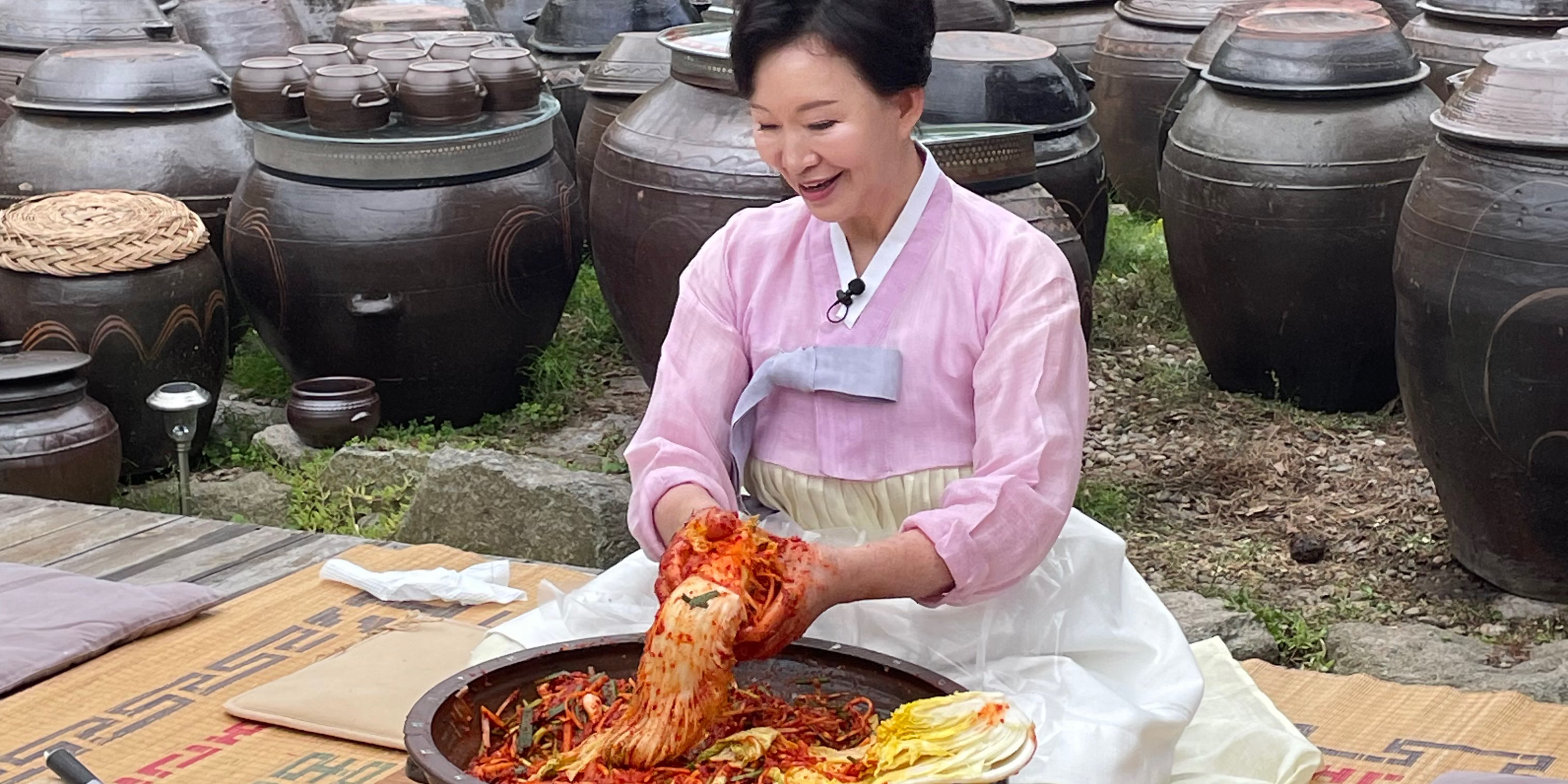
For our October trip, we visit Master Lee Ha-yeon at her studio in the countryside of Namyangju. She is Korean Food Grand Master No. 58, an official designation from Korea’s Ministry of Agriculture, Food and Rural Affairs, which recognizes masters of the country’s traditional foods. She was designated in 2014 for haemul seokbakji, a traditional seafood-rich kimchi with roots in Korea’s western coastal food culture.
Her studio is in a picturesque village surrounded by low, green mountains. Outside is a large garden filled with hundreds of onggi jars of different sizes, containing all kinds of kimchi and fermented condiments. The last time I visited, she was teaching a group of Michelin-starred chefs visiting from France, and they were all standing around enormous bowls with their hands and arms deep in kimchi seasoning.
One of the things I want our guests to learn from her is just how vast the world of kimchi really is. Outside Korea, kimchi often means one thing: The familiar red, spicy Napa cabbage kimchi. But almost any vegetable can become the starting point for kimchi, from radishes and cucumbers to green onions, mustard greens and tender radish leaves and stems.Some kimchi is meant to ferment and mature for months, while other varieties are made to be eaten almost immediately. What you make changes with the season, the region, the available ingredients and how the kimchi is intended to be eaten.
And then there is Master Lee herself. She is always impeccably dressed in a beautiful hanbok. She watches everyone closely, makes sure nobody gets lost along the way and, most importantly, makes sure everyone is well fed. There is something very Korean about that combination of mastery and hospitality.
Why is fermentation so important in the flavor balance of South Korean food?

Fermentation gives Korean food much of its depth. Many Korean dishes are actually quite simple in their preparation: A bowl of steamed rice, blanched and lightly seasoned vegetables, grilled fish, perhaps a soup. What gives that seemingly simple food so much flavor are ingredients like doenjang, ganjang, gochujang and jeotgal, or salted and fermented seafood. Fermentation transforms soybeans, vegetables and seafood, developing layers of savory, earthy, acidic and aromatic flavors. Sometimes, just a small amount of a fermented ingredient can transform an entire dish.
Those strong flavors are always part of a larger balance. Something deeply savory might be paired with fresh vegetables; something rich with acidity; something salty with a relatively plain bowl of rice. And that balance happens not only within individual dishes, but across the entire Korean table. Plain rice sits alongside savory fermented foods, while vegetables, soups and other side dishes bring different flavors and textures to the meal. The balance comes from eating them together.
What fascinates me most is that fermentation makes time part of the flavor. Freshly made kimchi tastes completely different from the same kimchi weeks or months later, and jang can continue to mature for years. Time becomes an ingredient. Some of the most distinctive flavors in Korean food come from simply giving microorganisms, nature and time the opportunity to transform what you started with.
Is there a South Korean fermented food you wish more people knew about?
I love galchi sokjeot, a type of jeotgal made by salting and fermenting cutlassfish. It is salty, of course, but also ever-so-slightly sweet and deeply umami, with a gentle fermented tang in the background that makes it incredibly addictive.
What I especially love is the way we eat it. It is often served with ssam, an assortment of leaves and vegetables for wrapping rice, fish or meat. You might have steamed cabbage leaves, green and red lettuce, perilla leaves, and in coastal areas, an array of fresh seaweed.
Another type of fermented fish I love is meljeot, which is made with large anchovies caught off the coast of Jeju Island. At many pork barbecue restaurants, it comes to the table in a small stainless-steel bowl that sits directly over the flames of the grill. Minced garlic and sliced spicy green chilies are often added, and the mixture bubbles away next to the meat as you cook. Dip a piece of fatty grilled pork into the bubbling sauce and let it soak for a few seconds. For me, there is no better seasoning for that piece of pork.
There seems to be a contrast between the pace of fermentation versus the pace of modern life?
Korea is an incredibly fast-moving society. We are used to things happening quickly, whether it is technology, delivery, transportation, administration or simply the pace of everyday life. And yet, when it comes to some of the foods we value most, we still rely on one of the slowest processes imaginable: fermentation.
I find that contrast fascinating. You cannot rush a jar of doenjang or ganjang. Kimchi changes on its own schedule. This slow tradition has survived right in the middle of a very modern, very fast Korea because we still depend on it for something that gives us enormous pleasure every single day (food). There is something wonderful to me about that contradiction.
What foods are you most excited to share with the guests on our trip?
All of it. Possibly the best pork barbecue in all of Korea, all the kimchi, banchan and soups, the freshest seafood straight from the tank and a fine-dining experience. But more than what I want them to try, I am excited about how they will eat it. I want them to experience the way Koreans actually eat: Several dishes on the table at once, taking a bite of rice with one banchan, then some soup, then something else, moving back and forth between different tastes and textures. There is no prescribed order.
Visitors often arrive in Korea with a list of famous dishes they want to try, and of course that is part of the fun. But I think there is something much more revealing about sitting down for an ordinary Korean meal and eating the way people here eat every day. That is the experience I am most excited to share.
Join the conversation on Facebook, Instagram, TikTok and Pinterest.
And if you're looking for more Milk Street, check out our livestream cooking classes with our favorite chefs, home cooks and friends for global recipes, cooking methods and more.

Rosie Gill
Rosemary Gill is the Director of Education at Milk Street Cooking School. An educator dedicated to helping people create lasting home cooking habits, she oversees the development of hands-on and online cooking classes as well as Milk Street's community initiatives.
